Creative Nonfiction (Gratrick, N 2022)

There’s a misconception about karma in the western world; that it is somehow linked to fatalism or luck, something external and uncontrollable. We talk about a person having good karma as if it’s a positive force or callout misfortune by saying ‘karma’s a bitch’ as if it can weigh the scales of favour against you. None of these are true.
Your karma is the debt you have paid through your actions, good or bad, in this life for the next. It’s the tally your soul takes with it when it steps through the door at the end of the tunnel of light; your currency in the afterlife. Your karma is what you carry when you go to meet the Goddess.
Ancient stories tell of a sky river, the Akash Ganga, that spilled out across the eternal sky renting the darkness. Convinced to descend from the heavens to wash away the sins of mortals, this celestial being flooded through the locks of Lord Vishnu alighting at Gangotri where she crystalised, encrusting her path with diamond ice. Today, where the mountain glacier meets the Himalayan plateau, sits the ice cave of Gaumukh, its ragged mouth open like an old man without his dentures, waiting for a kiss.
Drop by drop, the frozen Akash Ganga melts into the waiting arms of the River Bhagirathi, who ripples through the hollows, her voice a swirling echo. Downwards she flows, snatching at the fingers of her feeding tributaries, belly swelling through the narrow gorges to Devprayag. Here she meets her sister, Alaknanda, the other of the major headstreams born from the Vasundhara Falls over 30 miles away, and at the confluence where two rivers converge, the Goddess Ganga is born.
***
‘I’m not afraid,’ he told me once.
His dressing gown hung loosely over his diminishing frame as he waited for me to arrive from London. It was a Friday. The vivid, decades-old bypass scar looked hitched up as the skin around it sagged, losing its colour from the inside. The misty halo around his irises was lighter under the sharp hospital lights and I wasn’t sure how much his cataracts let him see. A white wave of hair swept away from his forehead, still stark against the translucent darkness of his skin and salt and pepper whiskers merged unabated with a moustache that had gone haywire.
‘They won’t tell me when I can go home.’ He was tired.
‘They need to be sure Dad,’ I told him even though I knew he wasn’t listening.
‘Every night, with these old men snoring so loudly and groaning all the time,’ he continued, ‘I can’t sleep.’
I laughed. Mum had banished him to his own room decades ago because of his snoring. He laughed too but it didn’t make it all the way up to his eyes. I remember thinking eight weeks isn’t enough time to say goodbye.
‘Have you got your book?’
We were transcribing his recipes, all those I’d grown up with that were only in his head and had started a few weeks ago with jeera chicken. I’d wanted to draw around his hand so I would know what a ‘thumbful of garlic’ or a ‘finger of ginger’ really looked like, but he told me to use my own as if the secret was in the balance and not the measurement.
‘I don’t have it today,’ I told him, ‘So maybe we can record it’.
I pulled out my phone and he took it from me, eyes opening wide as if that would help him see it more clearly and for the next hour, he taught me how to cook his famous prawn curry, even though my allergy will prevent me from ever making it. We talked about Ma and my sister Piu; about dharma, his duty and obligation to give us the foundation to live happy lives; about this life and the next; about choice.
I drank terrible tea and consumed my own body weight in Custard Creams.
‘Ask her,’ he pointed at a harassed nurse, rushing to the last bed, plastic clean-up sheets bundled into her arms.
‘She’s busy,’ I told him as I watched her pull the curtain round the patient at the far end, ‘they’ll let us know when they can.’
‘I want to go home,’ his voice, damaged by diphtheria as a child, was no more than a whisper.
Holding his hand, veins luminous in the light, ‘I know,’ I told him.
***
Kolkata is a complicated city. Having spent most of my childhood summers there I’m not a tourist but equally cannot pass as a local, as if the chaos of the city hasn’t fully permeated my soul. Derelict yet regal where past and present collide, you see supercars sharing road space with ox-drawn carts and the scent of the British Raj still lingers as rickshaw wallahs run barefoot through the city carrying their passengers like royalty. Tattered banyan trees line the roads, carving up the footpaths as they reclaim root-space and memorials are surrounded with shanty-houses each with a requisite tourist scout – a child beggar, eyes rimmed with kohl, daring you to look away.
‘Can I share my rosogolla Ma?’ I was a child, maybe five years old, on our second visit.
We had bought the warm, fresh balls of sugary heaven on the way back from my aunt’s house one late afternoon. They were my favourite, and I could easily eat 10 in one go.
‘No, we don’t give to beggars,’ she told me, pulling me sharply away from a little girl of about the same age.
I stared at her as she stared at me. I don’t remember why. Perhaps, in the brightness of that exotic Wonderland so different from my own home in the suburbs of Bath, these free-roaming children whispered of excitement and adventure.
***
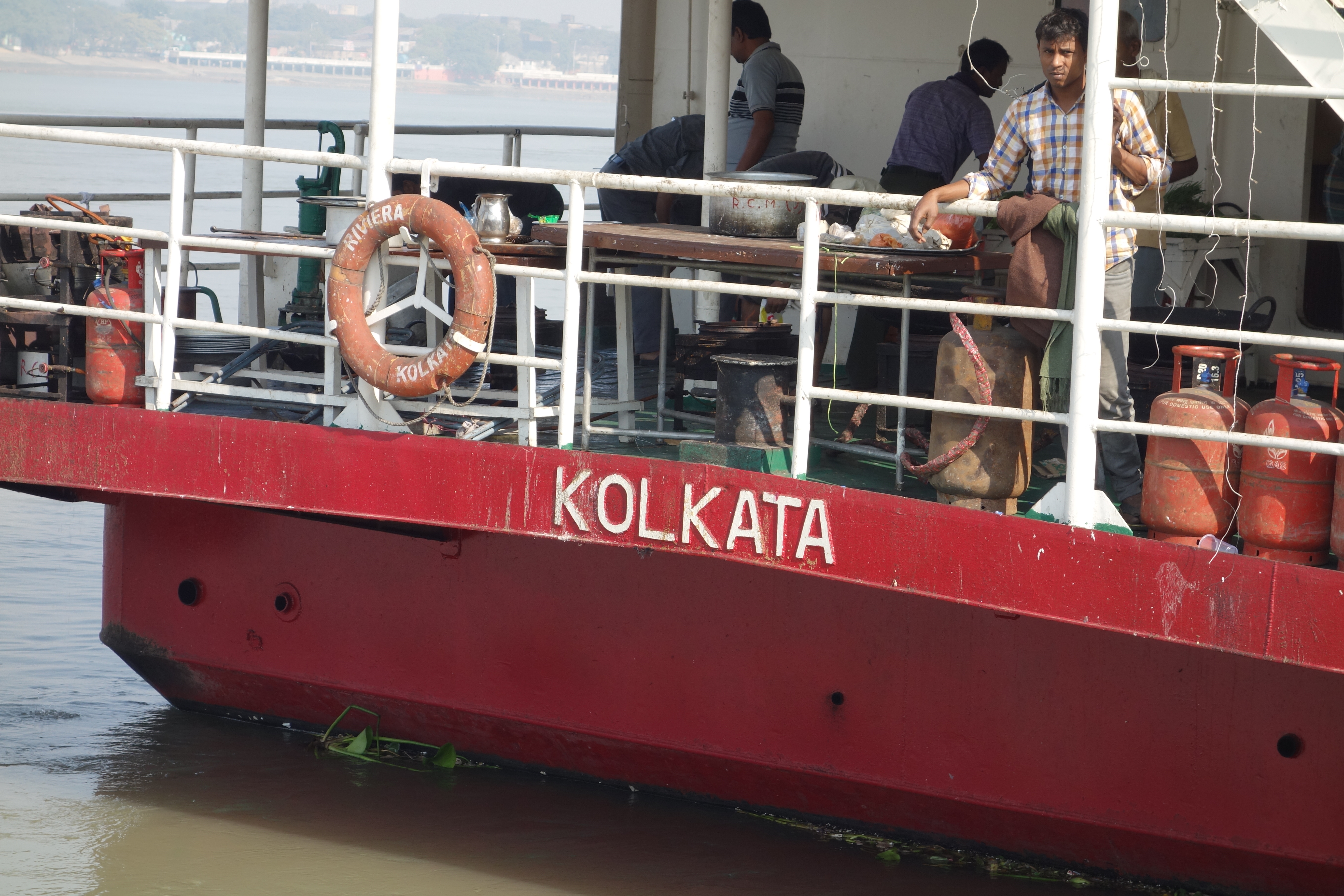
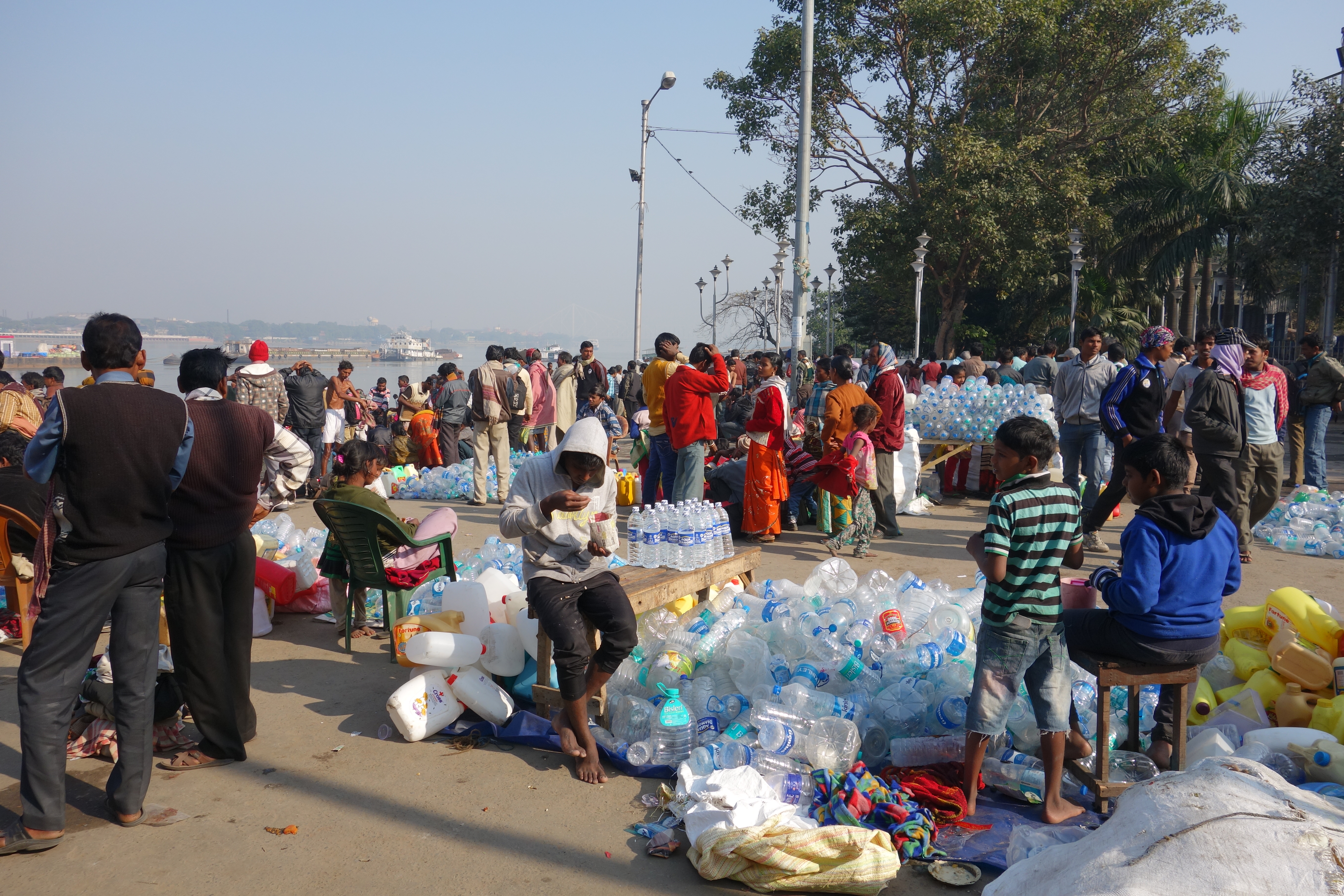
At the Outram Ghat on December 27th, 2015, it was a hazy grey morning, but the early sun had softened winter’s bite. Women layered in shawls and cardigans over multi-coloured saris crowded along the promenades of the River Ganges as the city of Kolkata woke up. Yellow ambassador taxis chugged, impatient horns blasting even at that time of day and schoolgirls with slicked, symmetrical braids clambered onto busy commuter buses already packed full of rooftop passengers wrapped up against the cold.
As we disembarked from the taxis, most of the people in our vicinity stopped to stare. Bengalis have no shame or subtlety when it comes to staring. But who can blame them? Two mixed race families with a matriarch; no shawls in the 20 degrees ‘cold’; no tank tops or moustaches on the men. To them, we must have looked very strange.
As someone who gets very cold hands, tank tops are a bit of a puzzle to me. Why have a jumper without sleeves, especially in India where most men usually wrap a shawl over themselves anyway? Why not just have sleeves? Surely that would be simpler? But on the slopes of the ghat that morning, tank tops in various shades of brown and grey, and sandals with socks were the fashion must-haves. Barefooted boys, hair cropped as haphazardly as their trousers lumbered by, sacks laden with empty plastic bottles. These accidental eco-warriors looked tiny in comparison to their loads but twittered happily between themselves. Someone was selling egg rolls, the Bengali bacon sandwich. They smelled divine.
‘So, this is the place?’ I asked Ma.
‘Yes, not the best or the quietest,’ she shrugged, ‘but this is the easiest to park.’
I remember thinking that perhaps parking considerations shouldn’t have been that high on the list for ‘best places to scatter your dad’s ashes’, but it wasn’t the right time to mention it. Ma isn’t comfortable in Kolkata anymore. Having left in her twenties, she had spent all her adult life in England and this city made her nervous, as if at any moment something could go horribly wrong; unlike Dad, who would have revelled in it and most definitely have bought us eggrolls despite the potential for food poisoning.
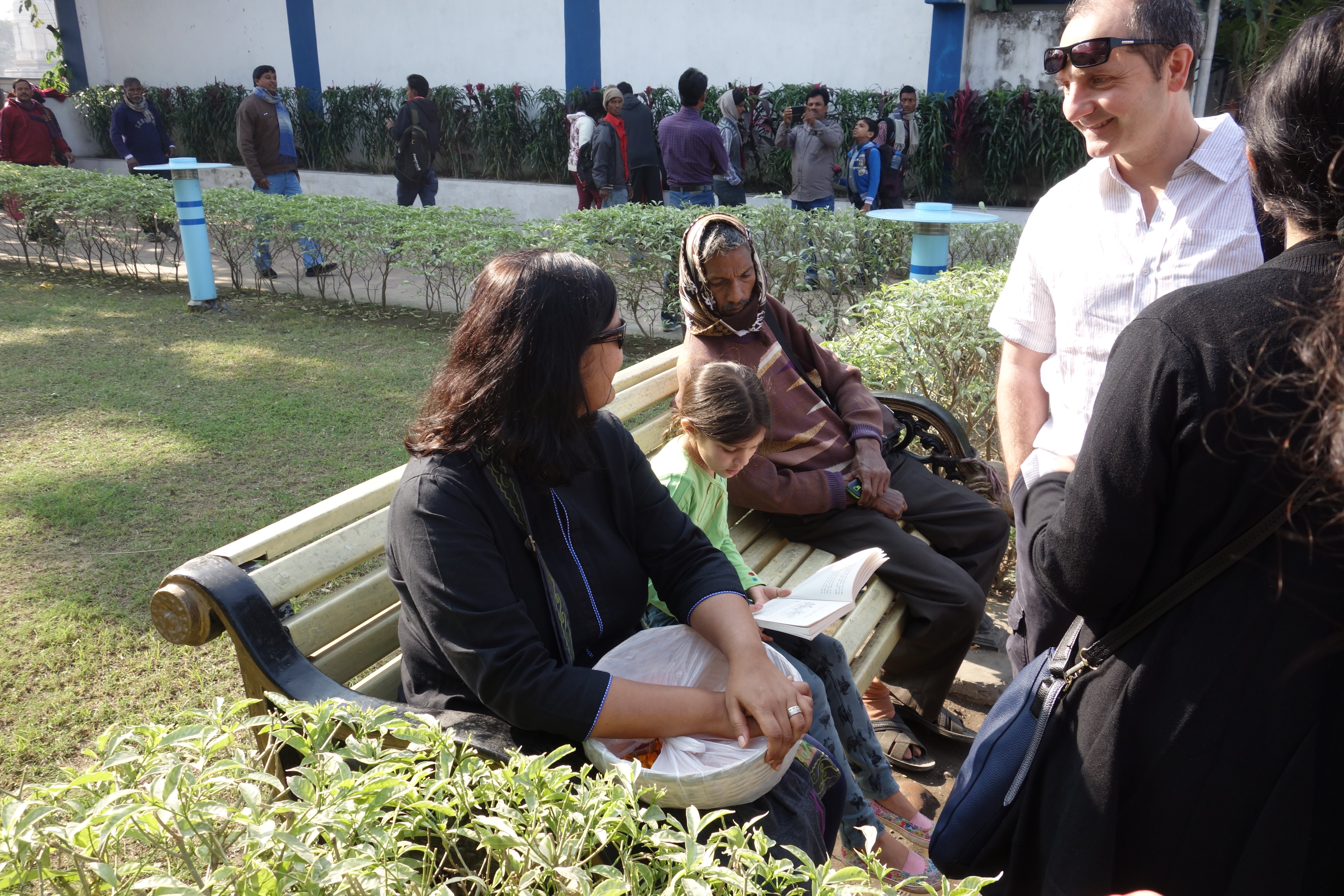
We waited for one of the main ferries to pull away, hoping the crowd would thin and Ro, aged five, sat down on a bench to read her book, something about frogs and spells. Over her shoulder, a man with a greying beard, a shawl wrapped over his head and around his regulation tank top, leaned in, as if to read it with her. As she turned the pages, he leaned in closer to look at the pictures. After a few minutes she stopped and stared at him as only a child could. He simply stared back. It’s a Bengali thing.
As we walked down the slopes of the ghat, passed its colonial ferry terminal, that distinct smell of India, fried onions laced with cumin, crushed cardamom and clove interwoven with the underlying stench of rotting vegetation and manure, wafted up from the river and both of our daughters wrinkled up their noses. First time in India that smell gets to everyone. Oh, and the sight of grown men bathing in public; lunghis tied tight; dipping themselves in and out of the murky water. Nothing really prepares you for that. A scene so personal made public but also mundane.
‘Why do they do that?’ Ruby, my eldest, asked me, ‘The water’s so dirty.’
At 10 with a keen interest in science, her concern had been primarily hygiene and not decency, but I had forgotten how strange this must seem to her. This alien landscape was so different from her home. I mean, can you imagine bathing semi-naked in the Thames? But here, as the bathers popped-up from the water, the sunlight warmed their skins making them glow like polished copper.
‘Not to them,’ was the best answer I could come up with.
The sanctity of water manifests itself across many religions. Christians baptise in water, and Buddhists and Muslims consider it divine, but none worship it in quite the same way as the Hindus. My Dad believed the River Ganges, the Goddess Ganga, was the holy thread that links birth, love, life and death.
But from the banks of the Hooghly, one of her main distributaries, she didn’t look holy. Scratching beneath the surface, her derelict shore was lined with rusted boats and twisted metal tangled in nets that clotted the river with detritus. Bloated jelly-fish bags bobbed in and out of the reed beds as iridescent oil slicks streamed across her surface, staining her skin. She looked unkempt and hungry, her ravenous flow grasping at anything and everything she passed, carrying it with her regardless of reason.
This was not how I expected to say goodbye.
In my mind’s eye, I cast him into crystal clear waters that ebbed and flowed gently away. We may have said a prayer, there may have been the high-pitched chime of tingsha cymbals. But this living morass filled me with guilt which sank like a stone from my head into the hollow of my heart, overshadowing our final moments together. How could he find peace here? How could this be his last resting place?
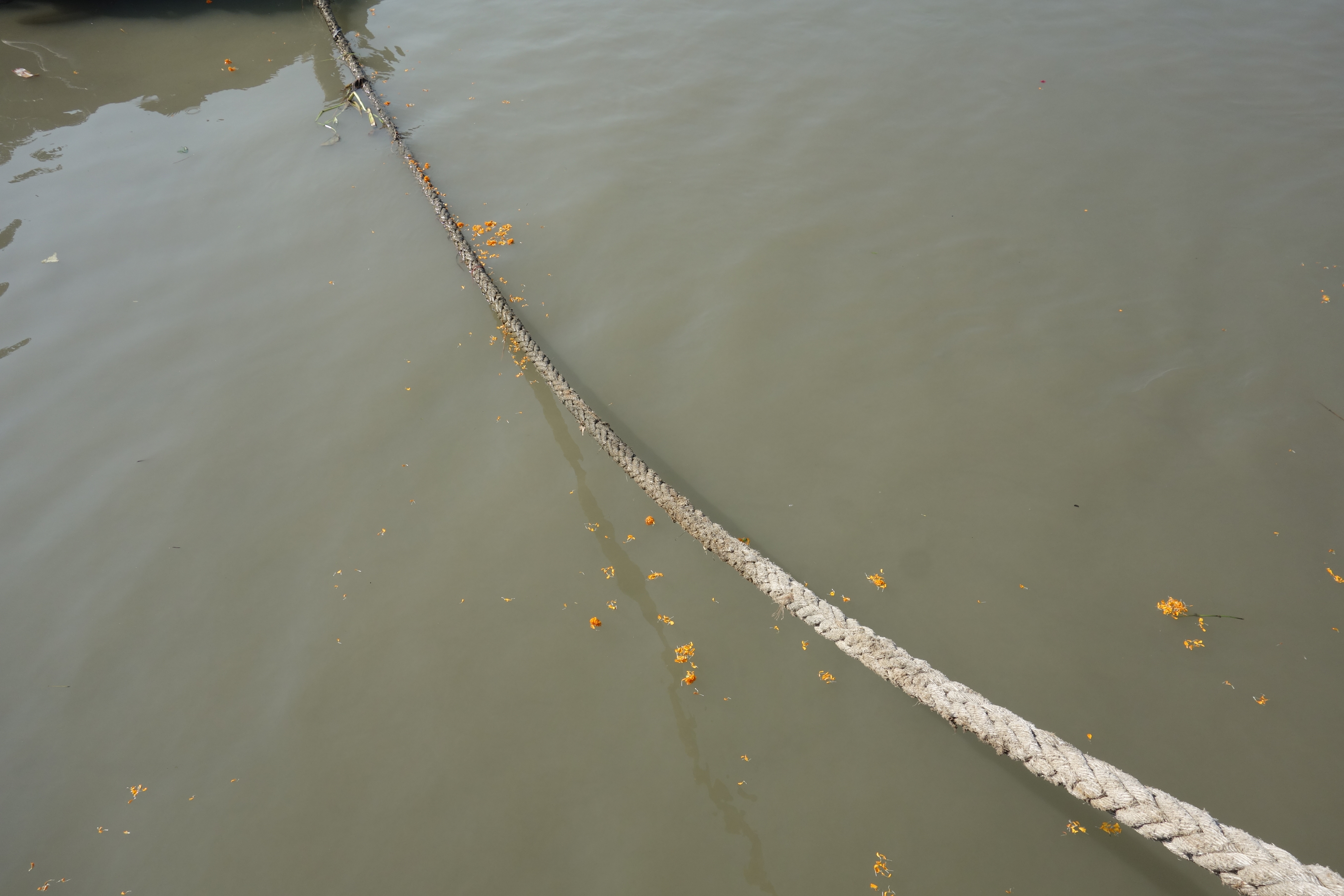
Standing at the edge of the jetty, ashes mixed with marigold petals, we held him one last time in our hands. As we scattered him into the arms of the Goddess, the vibrant flecks of orange glittered in the sun and the surge swept him diagonally into her centre.
My husband Vince pulled me in for a hug, sensing as he always does when I need a moment.
‘This place is horrible,’ I whispered into his shirt, tears stinging.
He laughed, ‘This place is India.’
Looking up at the hurricane of life in front of me I realised he was right. This is exactly where Dad would want to be. Here, in the city of his heart with its ramshackle glory hiding beneath a canopy of chaos, he was home.
 The Curious Wordsmith